The Psychology Board of Australia has now released its report following consultation on proposed changes to psychology education and training.
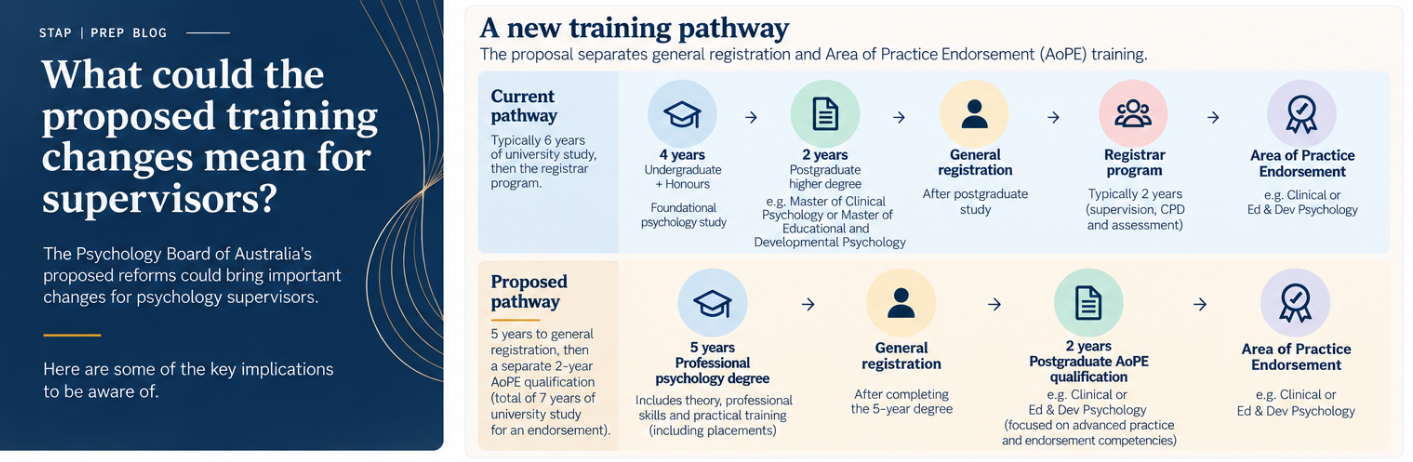
A lot of the discussion has understandably focused on students and the proposal to reduce the pathway to general registration from six years to five. But if the reforms go ahead, there could also be some significant implications for psychology supervisors and the way supervision is delivered in Australia.
There is still plenty we don't know, but the consultation report gives us some useful clues about the direction the Board is considering.
One thing that seems clear is that supervision isn't going anywhere.
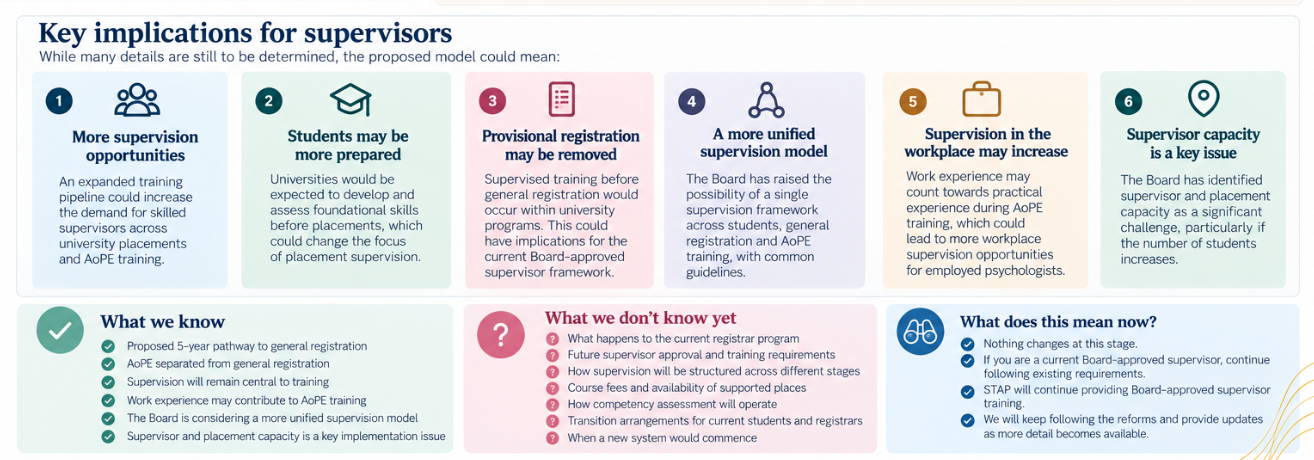
In fact, the proposed model could make the availability of skilled supervisors even more important.
Under the proposed pathway, students would develop professional skills progressively throughout a five-year accredited psychology program, including practical training and placements before becoming eligible for general registration.
The Board acknowledges that increasing the number of psychologists moving through training also means ensuring there are enough placements and appropriately skilled supervisors to support them. Supervisor and placement capacity were both identified as significant implementation issues during consultation.
For supervisors, that raises some obvious questions about who will supervise these students, what qualifications supervisors will need, how supervision will be funded and how universities and workplaces will create enough capacity.
The report also makes an interesting point about what happens
before students arrive on placement.
Under the proposed model, universities would be expected to teach and assess foundational professional skills before students enter real-world practice.
This is important because the Board acknowledges the considerable responsibility currently placed on supervisors when provisional psychologists arrive at placements with varying levels of professional skill development.
The proposed approach is intended to mean that students arrive better prepared, allowing placement supervisors to focus more on helping them apply, integrate and consolidate their skills in practice.
Whether this works as intended will depend heavily on how "placement ready" is defined and assessed, but it could change the expectations placed on supervisors in student placements.
One of the more significant proposals is the removal of provisional registration from the redesigned pathway.
Currently, provisional registration and Board-approved supervision are closely connected. Under the proposed model, supervised training before general registration would occur within accredited university programs. Students would be regulated as students during this period and would graduate eligible for general registration.
If this proceeds, it raises an important question for current and future Board-approved supervisors:
What happens to the existing Board-approved supervisor framework?
The consultation report does not answer that question yet. The Board has also indicated that removing provisional registration would require further consultation.
So there is no suggestion that supervisors need to change anything now, but this is certainly an area STAP will be watching closely.
Perhaps the most interesting part of the report from a STAP perspective is the Board's discussion of the current supervision system.
At the moment, psychologists supervise across several different contexts, including student placements, provisional registration pathways and registrar programs. Different requirements can apply depending on who is being supervised and where they are in their training.
The Board sees the proposed reforms as an opportunity to consider: "one unified supervision model with common supervision guidelines and to support sustainable access to supervisors."
We don't yet know what a unified model would look like, but it could have significant implications for supervisor training, approval and ongoing competency requirements.
It could also potentially create a clearer framework for supervision across the different stages of psychology training.
The proposed changes to Area of Practice Endorsement training are also relevant to supervisors.
Under the proposed model, psychologists wanting an AoPE would first become generally registered and then undertake a separate two-year accredited postgraduate qualification.
The Board has also proposed that work experience may count towards practical experience during AoPE training, rather than relying solely on traditional university placements.
If psychologists are completing advanced training while employed, workplace supervision could become an important part of developing and assessing advanced competencies.
Exactly how AoPE supervision would operate, and what happens to the current registrar supervision framework, remains to be determined.
There is also a very practical problem.
You can't substantially increase practical training without increasing the capacity to provide supervision.
The Board acknowledges that the existing approach to placements and supervision is not sustainable if psychology training expands significantly. Building supervisor capacity has therefore been identified as an important part of implementing the reforms. STAP lead Dr Aaron Frost is on record as stating that the problem is not a shortage of supervisors (around 30% of the psychology workforce are Board Approved Supervisors), the problem is a shortage of people willing to supervise at well below market rates.
This raises questions beyond simply training more supervisors. Any proposal that focuses on increasing the number of supervisors, rather than finding the money to remunerate them properly, we predict will be a failure.
How much supervision can psychologists realistically provide alongside their clinical workload? Who pays for it? How do we encourage psychologists to become supervisors? How do we support supervisors to maintain their own competence? And how do we ensure adequate supervision outside metropolitan areas and large organisations?
These are issues that will need to be addressed if the proposed model is going to work in practice.
For now,
nothing changes.If you are currently a Board-approved supervisor, the existing requirements continue to apply.
The reforms are still being developed and there are substantial details yet to be determined, including the future supervision framework, transition arrangements and how supervision will operate across university training and AoPE pathways.
There is no need to retrain or change the way you are supervising based on these proposals at this stage.
At this stage,
STAP isn't changing either.We will continue providing Board-approved supervisor training under the current requirements.
But we will be paying particularly close attention to what happens next.
STAP has been training psychology supervisors for more than 20 years, so the possibility of a more unified national supervision model is particularly relevant to us.
Some of the biggest questions we will be watching are:
- Whether Board-approved supervisor status continues in its current form
- What training future psychology supervisors will be required to complete
- Whether the same supervision framework will apply across students, generally registered psychologists and endorsement candidates
- How supervision of work-based AoPE training will operate
- What happens to existing supervisors if a new framework is introduced
- How Australia develops enough skilled supervisors to support an expanded training pipeline
There is still a long way to go before we have answers to those questions.
What does seem clear is that supervision remains a critical part of the proposed future psychology training system. The structure around it may change considerably, and supervisors will need to be part of the conversation about what comes next.
We will continue to follow the reforms and provide updates as more detail becomes available, particularly where proposed changes could affect Board-approved supervisors and supervisor training.